Contractor management software for a mine should prove, before anyone starts work, that the contracting company is prequalified for the job and that each worker holds the right inductions, licences and competencies for that site. It should stop a non-compliant person at the gate and keep a dated record an auditor can check later. When you evaluate it, test it on a shutdown, when headcount jumps and the same contractor works across several sites.
Below are the records to ask for, the gate behaviour to test and the questions to put to every vendor. No product is picked as a winner. Products from the MSR directory appear at the end in alphabetical order, described as their profiles describe them.
Why contractor compliance breaks on mines
On many mine sites, a big part of the workforce is employed by contractors. Drilling, load and haul, earthworks, maintenance shutdowns, camp services and rehabilitation are commonly outsourced, and each contractor may bring its own subcontractors. The paperwork travels with them: company documents to the procurement team, tickets and medicals to the site, inductions to the training team.
It tends to break in three places:
- Shutdown peaks. Headcount can jump for a few weeks. Spreadsheets and inbox approvals that cope with a steady crew start to miss expiry dates when a large crew mobilises in the same week.
- Subcontractor chains. The principal contractor is approved, but the crew turning up belongs to a smaller company two steps down the chain that nobody prequalified.
- The wrong rules for the work. Which rules apply can depend on the activity, not only on the fact that it happens on a mine.
That last point came up recently in South Africa. In a supplied article published by Mining Weekly on 16 October 2026, the Bargaining Council for the Civil Engineering Industry (BCCEI) says that work often outsourced on mines, such as bulk earthworks, loading, hauling and dumping, access roads, rehabilitation and dust suppression, can be civil engineering work within its scope. "The physical location of the work is not what determines jurisdiction," the council's operations manager, Lindie Fourie, is quoted as saying. The council also says compliant companies receive letters of good standing, used in procurement. Mining Weekly's own report the same day carries the same statements from the BCCEI.
This article gives no legal advice on that or any other jurisdiction. The point for a software buyer is simpler: the system has to record which requirements apply to which contractor for which activity, and it has to let you change those rules without calling the vendor.
Company checks and worker checks
A mine needs both, and they are different records with different owners.
Company prequalification answers: is this business approved to do this scope of work on this site?
- Registration and identity. Legal entity, business registration, and the parent or principal it works under. Ask the vendor how a subcontractor is linked to the principal contractor.
- Insurance. Public liability, workers' compensation and any other cover the contract asks for, with the certificate, the amount and the expiry date. Ask what happens to the company's status the day after a certificate expires.
- Safety system. Safety management plan, incident history if you ask for it, and safe work procedures for the scope. Ask who reviews them and where that review is recorded.
- Industry and labour registrations. Whatever applies to that activity where you operate, such as the letter of good standing described above in South Africa. Ask whether you can add a new document type and attach it only to certain activities.
- Approved scope. Which work, which sites and which dates the approval covers. Ask whether a company approved for camp services can be blocked from a crew booked for earthworks.
Worker compliance answers: is this person cleared to do this task on this site today?
- Site induction, in addition to any generic or company-wide induction, with the date and version completed.
- Licences and tickets for the plant and tasks they will do, with expiry dates.
- Verification of competency (VOC), signed off by a named assessor, for site-specific equipment.
- Medicals and fitness for work where the site requires them, with the privacy controls those records need.
- Who approved each item, and when. Ask the vendor to show this on screen for one worker.
Check that the worker record links to the company record. When a contractor's insurance lapses, every one of its workers should show as affected without anyone re-entering anything.
From compliance to the gate
Compliance that lives only in an onboarding system is checked once, at mobilisation. Things expire after that. The test is what happens on the morning a ticket, a medical or a company's insurance lapses.
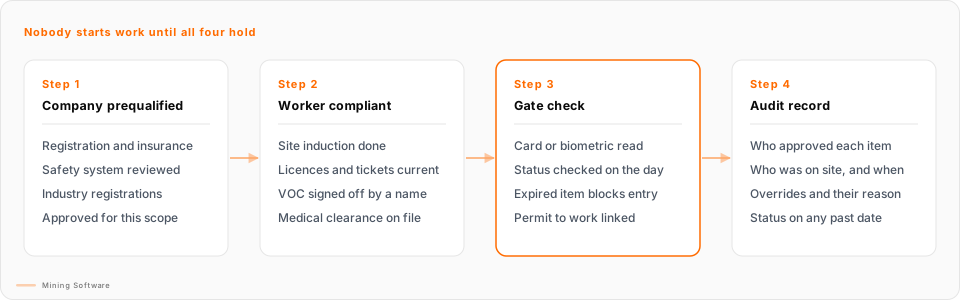
Ask to see four things working, not described:
- Status at the gate. The card reader, turnstile or biometric check reads current compliance, not a copy made at onboarding. Ask how often the gate system syncs, and what it does when the link to the compliance system is down.
- Expiry and lockout. A worker with an expired item is stopped, and so is everyone under a company whose approval has lapsed. Ask how much warning workers and contractor supervisors get before that happens.
- Overrides. Someone on site will need to let a person through. The system should record who did it, why, and for how long.
- Permits to work. If your permit system can check that the named people on a permit are compliant for the task, you close a gap between the gate and the job. Ask whether the two systems share a person record or only a name.
Audit trail and reporting
After an incident, or when a principal or regulator asks, the question is rarely "who is compliant now?". It is "who was on site on the night of the 14th, which company were they working for, and was everything current?".
The audit trail should answer that without a spreadsheet:
- Status of any company or worker on any past date, not just today.
- Every approval, rejection and override, with the person who made it.
- Which version of a site induction each worker completed.
- Gate entries tied to the compliance status at the moment of entry.
- Exports in a documented format you control, for reports the vendor did not build.
Reporting requirements differ by country, state and commodity. Ask your own HSE and legal teams which reports they need, then ask the vendor to produce them from test data during the pilot.
Where it meets rostering, fatigue and EHS
Contractor compliance sits between two other systems, and the boundaries matter.
Rostering and travel decide who is booked to arrive and when. The FIFO roster software checklist covers fatigue, flights and camp beds. The handover to check is simple: a contractor booked onto a swing should be flagged before travel if something will expire during it, not when they reach the gate.
Safety and environmental systems hold incidents, inspections and corrective actions. The ESG and EHS compliance software article covers those. The handover here is that an incident involving a contractor should link to that company and worker record, so contractor safety history is something you can query rather than reconstruct.
Some products in the directory cover more than one of these jobs. Others do one and integrate with the rest. Neither is wrong; ask how the person record moves between them.
A pilot plan for one shutdown
A shutdown is the right test because it is when the system is under the most load. Keep it short, using the approach in evaluating mining software without a six-month pilot:
- Load a real roster. Use the contractor list and crew numbers from a recent or upcoming shutdown, including subcontractors.
- Seed the problems. Put in an expired ticket, a lapsed insurance certificate, a missing site induction and a worker who moves between two sites.
- Run the gate. Check that each seeded problem is caught at the gate, and time how long an override takes.
- Change a rule. Add a new document requirement for one activity only, and see who can do it and how long it takes.
- Ask a past-date question. A week after the test, ask for the status of every person on site on the first day, with who approved what.
Write down what took a vendor call and what a site administrator could do alone.
Questions to ask every vendor
- How is a subcontractor linked to its principal contractor, and what happens to the subcontractor's workers when the principal's approval lapses?
- Can our site administrators add document types and rules for specific activities without a change request?
- How does the gate or card system get compliance status, how often, and what happens when the connection drops?
- How is an override recorded, and can it expire on its own?
- Can you show the status of any worker or company on a past date?
- How do contractors and workers upload and renew their own documents, and who verifies them?
- Where are medical and personal records stored, who can see them, and how is that access logged?
- What can we export, in what format, and what do we get back if the contract ends?
Where this sits in the directory
On 26 October 2026 the MSR directory listed 20 products from 16 vendors whose profiles mention contractors: 11 in workforce and roster management, 5 in exploration and drilling, 3 in environmental, ESG and compliance and 1 in fleet management. Many of the drilling and fleet mentions are about contractor data such as daily drilling reports, not compliance. None of the profiles below has a published user review on MSR yet.
Profiles that describe contractor onboarding, compliance or site access, in alphabetical order, as their MSR profiles describe them on 26 October 2026 (profile descriptions that MSR has not tested):
- Enterprise Protection Platform (Ideagen Workforce Safety): contractor onboarding, competency tracking and compliance verification, with biometric and card-based site entry checked against training, medical and induction records.
- Evotix Assure (SAI360): an EHS platform whose modules include contractor safety and compliance tracking.
- MyPass Organisation Passport (MyPass Global): compliance dashboards, competency matrices, onboarding workflows and document validation for mining companies and contractors.
- MyPass Skills Passport (MyPass Global): a worker-held digital record of training, licences and competencies that follows the worker between employers and sites.
- PeopleTray Workforce Management (PeopleTray): FIFO rostering and camp booking, with modules for training and compliance tracking and contractor management.
- RapidCrews (RapidCrews): workforce mobilisation for mining contractors and labour hire, with ticket and licence management, expiry alerts and compliance checking.
For the wider categories, see the workforce and roster buying guide and the ESG and compliance buying guide. If you use any of these products on site, a review on its profile helps the next buyer.
Sources: Bargaining Council for the Civil Engineering Industry, "BCCEI urges mining contractors to address growing compliance blind spot", Mining Weekly, 16 October 2026 (supplied article). T. Bulbulia, "BCCEI warns contractors to register with it and comply with collective agreements at mine sites", Mining Weekly, 16 October 2026. MSR directory profiles and review counts, 26 October 2026.
This article is general guidance, not legal or procurement advice. Check the requirements that apply to your sites and contractors with your own HSE, contracts and legal teams.
Frequently Asked Questions
Common questions on this topic, answered concisely.
- What is contractor management software for mining?
- It is the system a mine uses to check that a contracting company is approved for a scope of work, and that each of its workers holds the inductions, licences, competencies and medicals that site needs. Good systems connect that status to the gate and keep a dated record of every approval.
- What is the difference between contractor prequalification and worker compliance?
- Prequalification is about the company: registration, insurance, safety system and any industry or labour registrations that apply to its work. Worker compliance is about each person: site induction, licences, verification of competency and medicals. A mine needs both, because an approved company can still send an unqualified worker, and a qualified worker can arrive under a company whose insurance has lapsed.
- Should contractor compliance be checked at the mine gate?
- Yes, if the gate or card system can read compliance status on the day. Checking only at onboarding misses anything that expires between mobilisation and the shift. Ask each vendor to show a worker with an expired item being stopped, how an override is recorded, and how the record looks a month later.
Related Categories
Explore the software categories referenced in this article.
Related Buying Guides
Our guides to what to check before you shortlist software in these categories.