Phase 1: The Static Foundation: Why 3D Models Were the Essential First Step
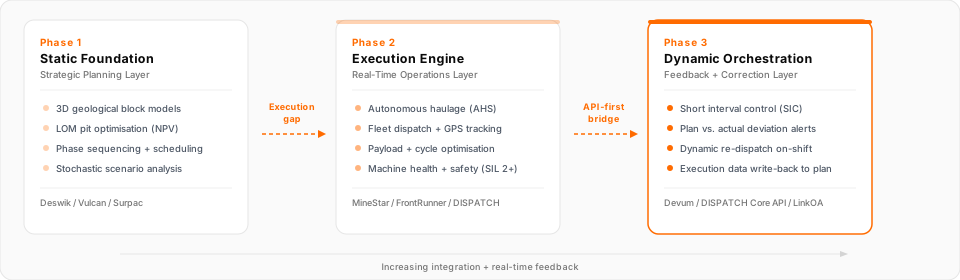
The foundational phase — static 3D geological and mine planning models — replaced paper cross-sections with models that guide extraction sequencing and economic evaluation.
The platforms that enabled this transition remain integral to modern mining operations:
- Deswik's 64-bit engine introduced stochastic scheduling, allowing planners to evaluate thousands of production scenarios against variable commodity prices and geological uncertainty.
- Maptek Vulcan provided the 3D geological modelling framework with dynamic Gantt scheduling for life-of-mine (LOM) sequencing.
- GEOVIA Surpac delivered block modelling with a macro language that allowed sites to customise estimation workflows to their specific deposit characteristics.
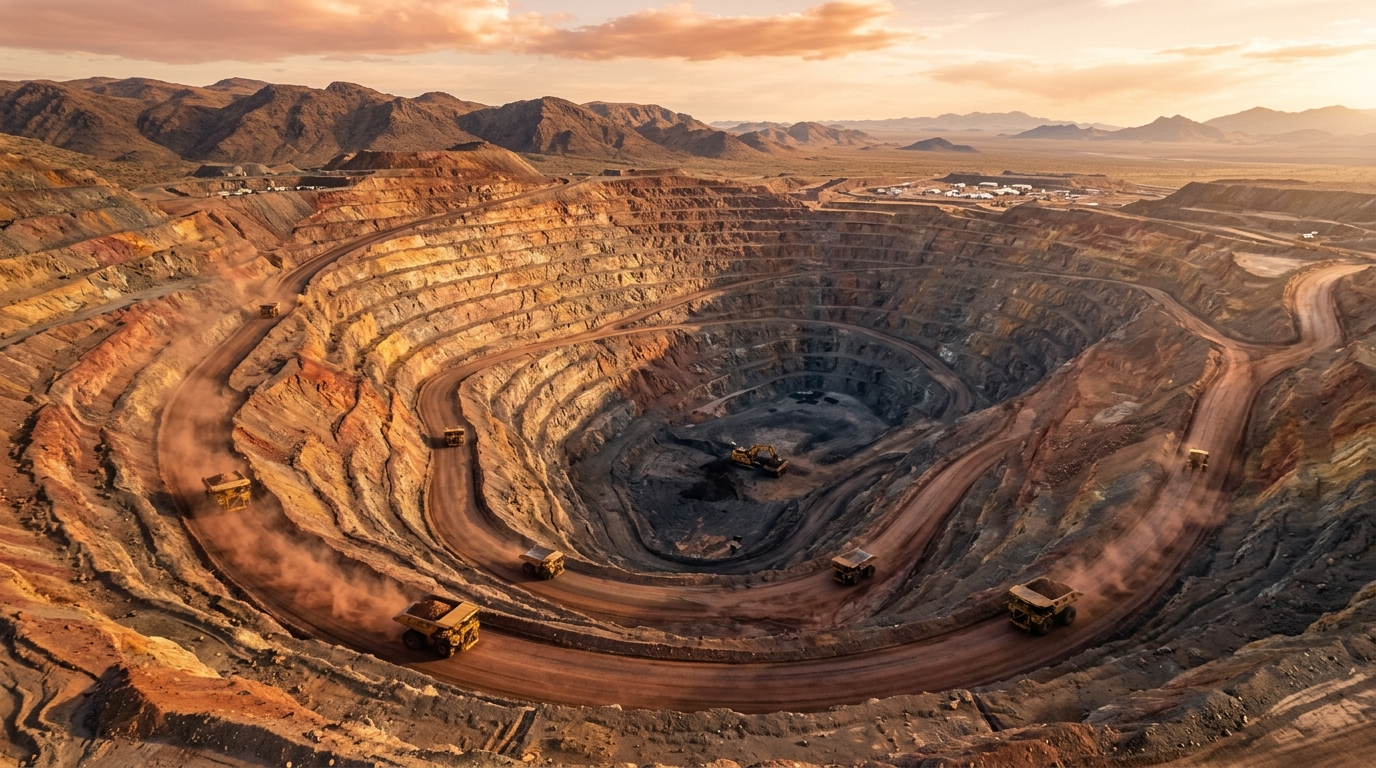
These platforms excel at spatial geometries and long-term economic constraints. Lerchs-Grossmann and its successors (Pseudoflow, network-flow optimisation) calculate ultimate pit limits that maximise NPV across the entire deposit — the computationally intensive problems Phase 1 platforms were purpose-built to solve.
They also established the data structures that remain industry-standard today. The block model is the common reference point for geology, engineering, and finance. Every estimation method populates the same structure, giving downstream consumers a consistent input regardless of methodology.
Modern pseudoflow implementations process block models with tens of millions of blocks across multiple commodity price scenarios simultaneously.
Planners generate pit shells across a range of metal prices and exchange rates, then select the sequence most robust against price volatility.
These platforms were built for strategic planning, not real-time operational control. They determine optimal extraction sequences over years and decades — not designed to ingest second-by-second IoT telemetry from 200 haul trucks.
Phase 2: The Execution Engine: OEM Fleet Mastery
OEMs embedded fleet management, machine guidance, and autonomous haulage into their hardware platforms, creating a separate execution layer alongside planning.
Caterpillar's MineStar Command tightly couples autonomous haulage, GPS tracking, payload optimisation, and machine health monitoring within Cat's proprietary hardware — which means a single vendor controls the full loop from dispatch decision to truck response.
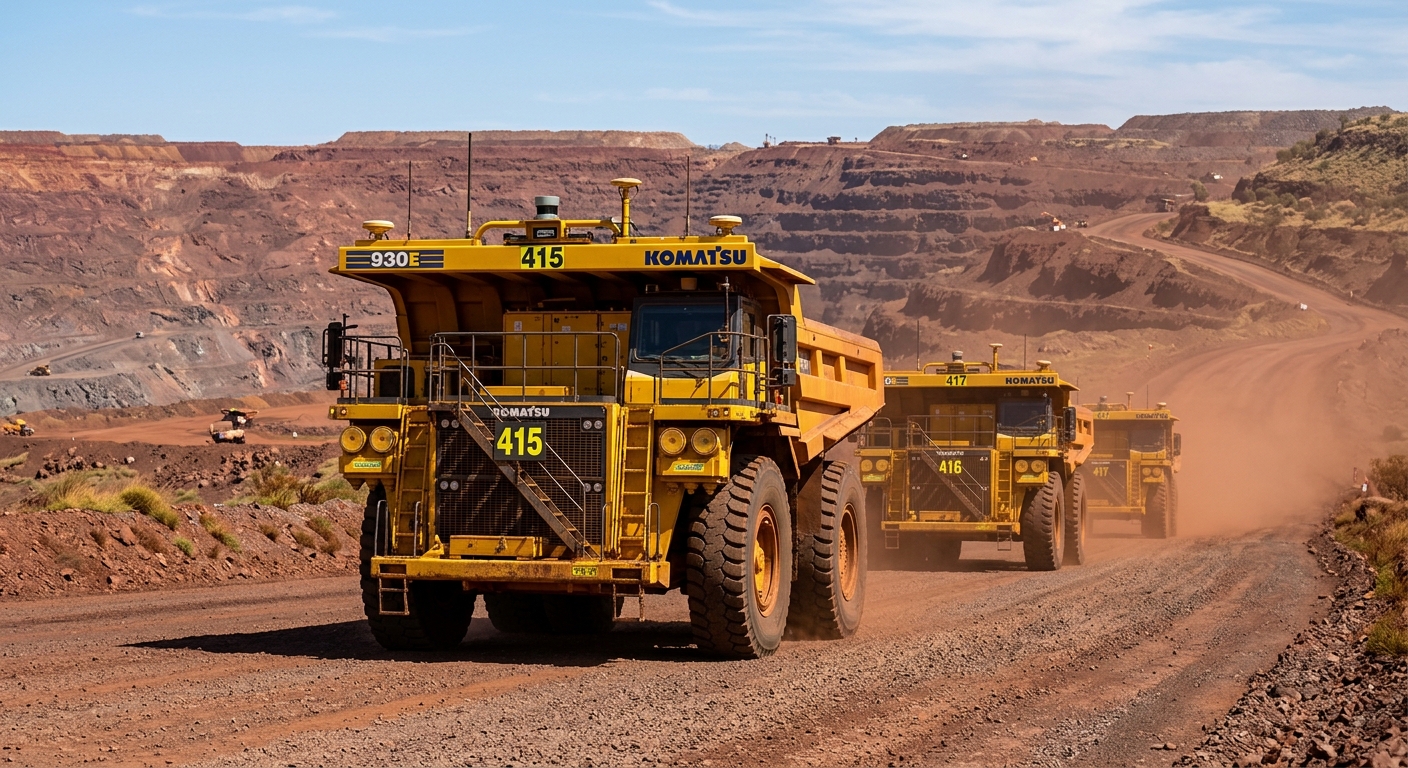
Komatsu's FrontRunner powers Rio Tinto's fleet of over 400 autonomous trucks across the Pilbara — the largest autonomous mining operation on Earth. Fortescue operates over 175 autonomous trucks, and BHP's South Flank runs more than 300.
For mixed-fleet operations:
- Modular Mining's DISPATCH (now part of Komatsu) provides vendor-agnostic dispatch optimisation and real-time assignment algorithms across heterogeneous fleets.
- Wenco International offers OEM-agnostic fleet management and production information systems.
- Hexagon's mining division (formerly Leica Geosystems and SAFEmine) delivers machine guidance, collision avoidance, and fleet management across mixed-OEM environments.
- Epiroc's RCS enables fully autonomous surface drilling, reducing operator exposure while improving drill pattern accuracy.
Autonomous haulage systems operate under SIL 2 or higher, with redundant perception and deterministic control loops. The response hierarchy (slow, stop, park) executes in milliseconds.
Proprietary telemetry formats, API structures, and schemas ensure deterministic safety behaviour. But they create real complexity when technical services teams need to reconcile execution data against the planning model in a different software ecosystem.
Phase 3: Dynamic Orchestration: Short Interval Control and the Bridge
The gap between plan and execution is where value leaks. The numbers tell the story:
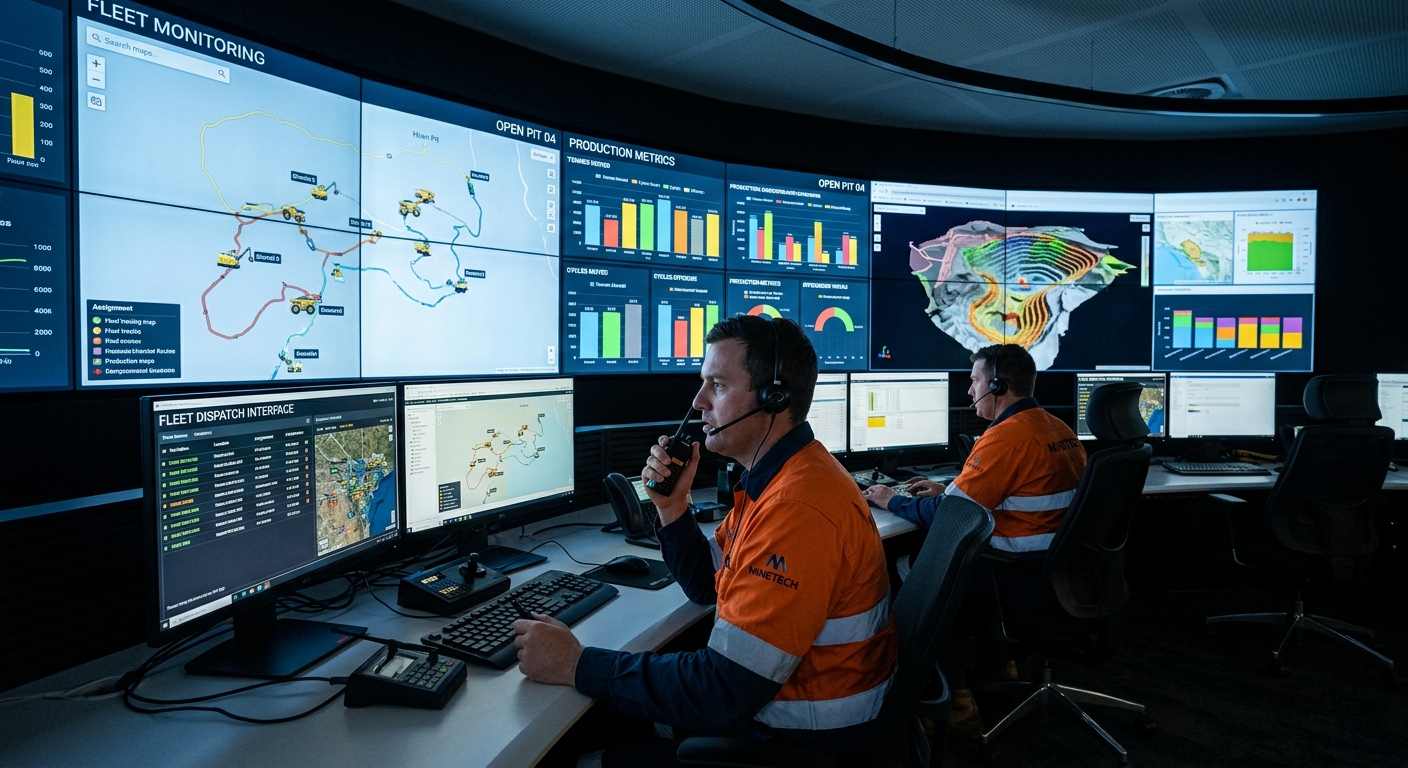
The SIC loop operates as a continuous cycle:
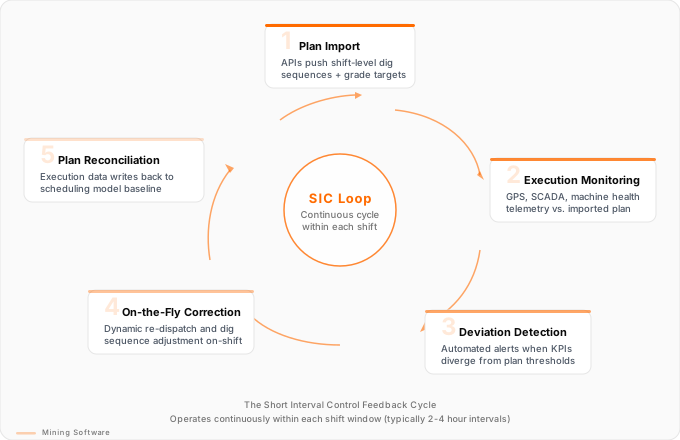
- Plan Import: APIs connecting scheduling software to the fleet management system, pushing shift-level dig sequences, grade targets, and material routing rules.
- Execution Monitoring: Real-time telemetry ingestion from GPS, SCADA, and machine health systems, tracking actual material movement, equipment status, and grade performance against the imported plan.
- Deviation Detection: Automated alerts when KPIs diverge from plan thresholds — a truck breakdown, a grade excursion, a loader reassignment that disrupts the blending strategy.
- On-the-Fly Correction: Dynamic re-dispatch and dig sequence adjustment within the shift window, recovering production before the deviation compounds into a missed daily target.
- Plan Reconciliation: Data write-back from actual execution metrics to the scheduling model, updating the planning baseline with operational reality for the next cycle.
The architectural enabler is API-first middleware. Reactore's Devum uses REST, MQTT, OPC UA, and Modbus protocols to translate between proprietary OEM telemetry and planning system data structures.
Multi-brand fleet translators like Epiroc's LinkOA aggregate telemetry from mixed Cat, Komatsu, and Liebherr fleets into a single normalised data stream. Komatsu's DISPATCH Core API (launched March 2024) opened real-time fleet data to third-party consumers for the first time from within a traditionally proprietary ecosystem.
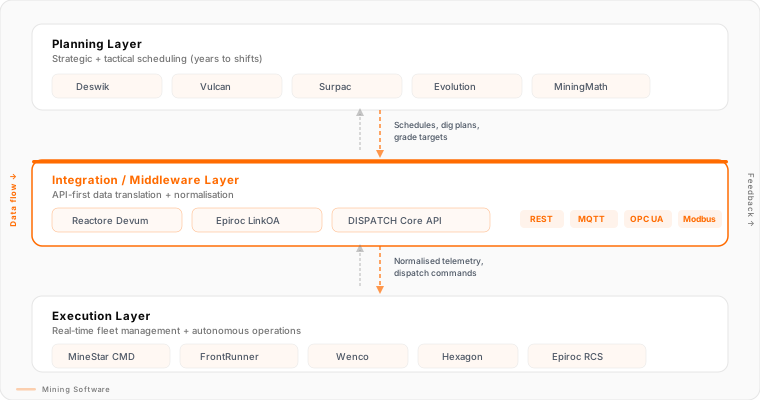
Private LTE and 5G SA networks provide the communication backbone. Latency requirements vary by function:
- Autonomous haulage safety commands: sub-100ms round-trip times
- Fleet dispatch decisions: 1–5 second refresh cycles
- SIC dashboards: 15–60 second aggregation intervals
Standardisation is gaining traction. The Open Mining Format (OMF v2.0 beta, Rust-based) provides cross-vendor data exchange, with Seequent, Dassault, Deswik, and Micromine committed to support.
Underground mining presents distinct challenges. GPS-denied environments require alternative positioning (UWB beacons, LiDAR SLAM, inertial navigation). Ventilation-on-demand is a natural SIC application — the control system must know where every active machine operates to optimise airflow energy.
Data governance adds complexity. When telemetry from multiple OEM systems feeds into centralised middleware, data ownership, retention, and access control must be resolved contractually before the technical integration begins.
The results support the investment:
- TIMining: 60-week case study demonstrated sustained plan compliance improvement
- Reactore (Indian bauxite): 30–40% faster dispatch cycle times, 20% improvement in grade blending accuracy
- Agnico Eagle LaRonde Zone 5: lateral development from 400–500m/month to 700m, plan conformance 70% to 94%
What This Means for Your Software Evaluation
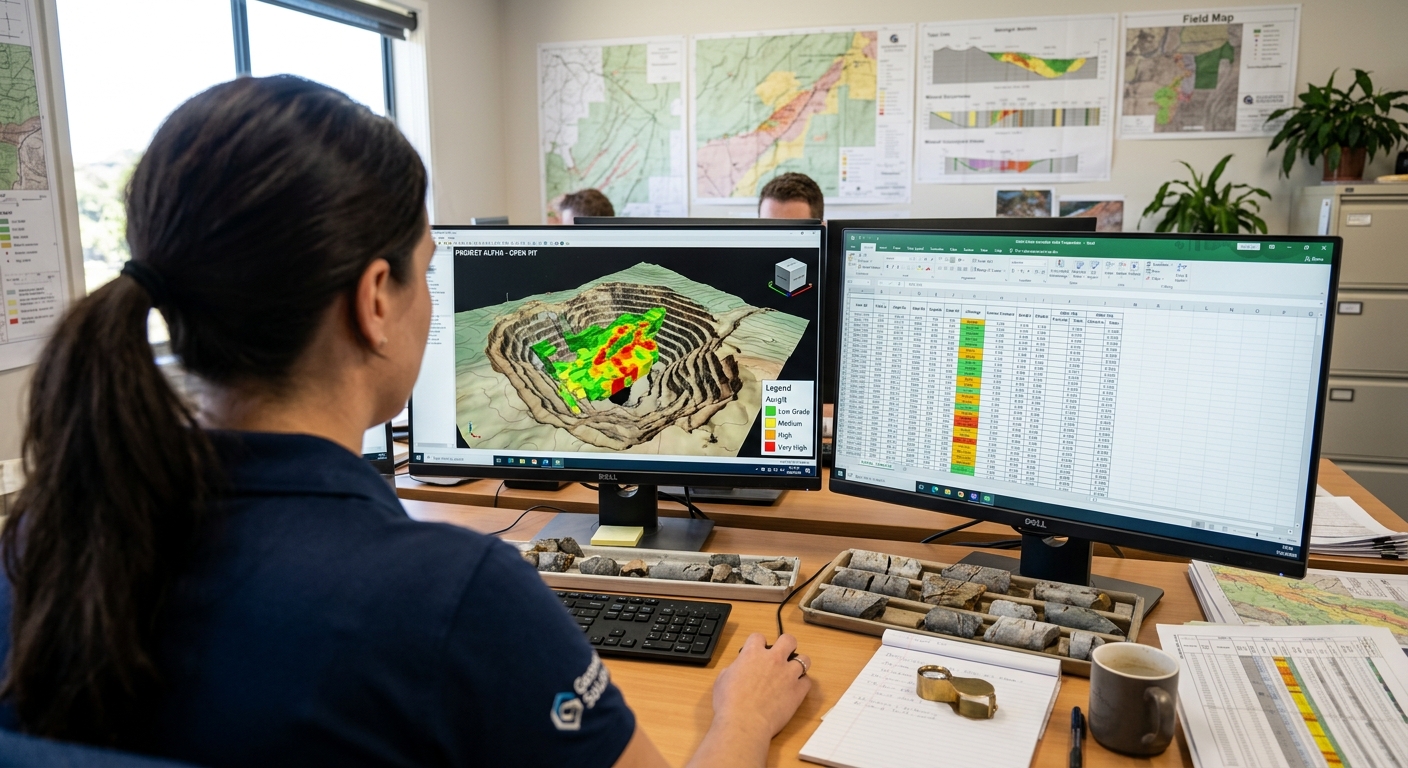
The maturity journey from static models to dynamic digital twins connects planning, execution, and feedback layers into a continuous loop.
Each phase retains its value. The question is whether your current software stack enables data flow between them.
When evaluating your technology architecture, consider these diagnostic questions:
- Planning layer: Can your mine planning software export schedules at shift-level granularity via an API, or are you manually transferring weekly plans via spreadsheet?
- Execution layer: Can your fleet management system push telemetry data to external systems via open APIs, or is telemetry locked within the OEM platform?
- Integration layer: Do you have middleware capable of translating between proprietary OEM data formats and your planning system's data structure?
- Feedback loop: Does actual execution data automatically reconcile against the planning model, or does reconciliation happen manually on a weekly or monthly basis?
- Telecommunications: Does your site have the network infrastructure to support continuous telemetry streaming from mobile equipment across the entire operational footprint?
Operations that build Phase 3 SIC loops on legacy Wi-Fi mesh networks encounter coverage gaps and latency spikes that degrade the feedback cycle. Private LTE and 5G SA networks provide guaranteed QoS from pit floor to crusher to waste dump.
Browse the directory to compare software across each phase. Phase 1 tools sit within mine planning and design. Phase 2 engines are in fleet management and dispatch. Phase 3 platforms span both simulation and digital twins and mine operations and SIC.
Frequently Asked Questions
Common questions on this topic, answered concisely.
- What is a digital twin in mining?
- A digital twin in mining is a dynamic, data-connected virtual representation of a mine site that mirrors the physical operation in near real time. It evolves through three maturity phases: static 3D geological and scheduling models (Phase 1), OEM fleet execution systems that track equipment in real time (Phase 2), and API-connected orchestration platforms that feed live production data back into planning models for shift-level re-dispatch (Phase 3).
- What are the three phases of mining digital twin maturity?
- Phase 1 is the static foundation: 3D geological models and long-term schedules built in platforms like Deswik, Maptek Vulcan, and GEOVIA Surpac. Phase 2 is the execution engine: OEM fleet management systems from Caterpillar MineStar, Komatsu Modular Dispatch, and Wenco that orchestrate trucks, shovels, and drills in real time. Phase 3 is dynamic orchestration: short interval control (SIC) and API-first middleware that closes the feedback loop between execution data and planning assumptions.
- Why do mining plans fail to execute without a digital twin?
- Industry data shows plan compliance rates as low as 30–40% when planning and execution systems operate in isolation. The planning layer runs on monthly or quarterly cycles against a static block model, while the execution layer responds to shift-level variability (equipment availability, grade variance, weather) with no structured feedback to the plan. The result is a compounding drift between what was planned and what was extracted, eroding value across the mine life.
- How does short interval control (SIC) improve mining operations?
- Short interval control platforms monitor production against the plan at shift or sub-shift granularity, detecting deviations (cycle time drift, grade variance, queue buildup) in time to intervene. When combined with dynamic re-dispatch and API-connected block models, SIC enables operations to reconcile actuals against plan assumptions within hours rather than months — the foundation of dynamic orchestration.
Related Categories
Explore the software categories referenced in this article.
Mine Planning & Design
Phase 1: Strategic planning foundations: pit optimisation, LOM scheduling, and block model-driven extraction sequencing.
Fleet Management & Dispatch
Phase 2: Real-time execution engines: truck assignment, GPS tracking, autonomous haulage, and cycle time optimisation.
Simulation & Digital Twins
Phase 3: Dynamic orchestration platforms: discrete-event simulation, live operational models, and scenario analysis.
Mine Operations & SIC
Phase 3: Short interval control dashboards: shift-level deviation detection, dynamic re-dispatch, and plan reconciliation.