Phase 1: Retrospective Reporting: The Governance Foundation
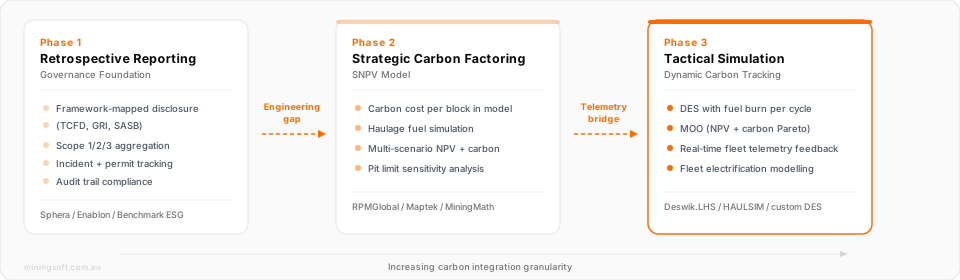
Enterprise ESG and environmental management platforms provide the essential governance infrastructure for mining operations. These systems are mandatory.
These platforms map site-level environmental data to the reporting frameworks that regulators and investors require: TCFD, GRI, SASB. They maintain the historical audit trails that allow a company to demonstrate its emissions trajectory over years and decades — required by law and material to valuation.

Platforms in this category centralise incident tracking, permit management, tailings dam inspection records, and statutory compliance reports. They aggregate Scope 1, 2, and 3 emissions data after it has been generated, providing the corporate ledger that sustainability directors use to report to regulators and prepare for external audits. Major platforms maintain databases of over one million emission factors, enabling operations across multiple jurisdictions to report accurately.
The jurisdictional complexity alone justifies the investment. An operation reporting emissions in Australia (NGER), Canada (GHGRP), and Chile (RETC) simultaneously must apply different methodologies, different emission factors, and different reporting boundaries for the same physical activities.
The data architecture underpinning Phase 1 platforms is built around hierarchical emission source taxonomies. Each mine site is broken down into discrete emission sources: haul fleet diesel, drill fleet diesel, blasting, processing plant electricity, dewatering pumps, light vehicle fleet, fugitive methane, and ancillary power generation.
Each source is assigned an activity data input and a jurisdiction-specific emission factor. The platform multiplies activity by factor and aggregates the result up through the organisational hierarchy to produce site-level, regional, and corporate totals. This calculation methodology is standardised under the GHG Protocol, but the engineering granularity of input data varies enormously — from manually entered monthly fuel invoices to automated telemetry from on-board fuel sensors.
These platforms were designed for governance and reporting, not spatial engineering. They tell you what happened — how many tonnes of CO₂e were emitted last quarter, whether tailings inspections met GISTM requirements, whether your facility exceeded its Safeguard Mechanism baseline.
They do not simulate what would happen if you changed the pit design, altered the haul route network, or transitioned to a deeper phase of extraction. That is what they were built for.
Phase 2: Strategic Carbon Factoring: The SNPV Model
Sustainability-Adjusted Net Present Value (SNPV) represents a fundamental shift in how mine planners optimise strategic pit designs. Traditional Lerchs-Grossmann pit optimisation maximises NPV by calculating the economic value of each block in the resource model: revenue minus costs. SNPV adds a carbon cost as a mathematical penalty on a per-block basis within the block model itself.
SNPV adds a "carbon density" attribute to each block. Each block is assigned an estimated carbon footprint based on the diesel fuel required to move it from its in-situ location to the crusher, waste dump, or stockpile. This carbon cost is a function of haul distance, elevation change, rolling resistance, and truck payload.

When the pit optimiser runs, it treats this carbon cost as a real economic penalty. Blocks that are carbon-expensive to extract receive a lower net value, which influences the ultimate pit limit, the sequence of extraction phases, and the transition depth from open-pit to underground mining.
Agosti et al. (2023) incorporated a carbon tax into Whittle/Datamine NPVS optimisation with geotechnically optimal non-linear pitwall profiles:
MiningMath's constraint-based approach showed that applying a GWP constraint at the third quartile achieved 91.9% of the baseline GWP while retaining 95.9% of NPV — a marginal abatement cost of just US$2.02 per tonne of CO₂.
GEOVIA's "Green NPV" analysis across 1,188 scenarios demonstrated that the ecological optimum reduced the damaged area by 31%, carbon emissions by 36%, and ecological costs by 35%, while simultaneously increasing NPV by 2.5%.
SNPV requires a specific data pipeline. First, a haulage simulation model calculates diesel consumption for every possible material movement pathway — from each block to every potential destination. This calculation is sensitive to haul road gradient, rolling resistance coefficients, truck payload, and speed limits.
The resulting fuel consumption per block is converted to CO₂e using jurisdiction-specific emission factors and attached as a block model attribute. When the pit optimiser runs, this carbon attribute is treated as a cost component alongside mining, processing, and haulage costs.
This changes strategic decisions. At the approximate 2025 ACCU trading level:
This can change the ultimate pit limit, the strip ratio, and the open-pit-to-underground transition depth. These are hundred-million-dollar decisions.
The commercial platforms enabling SNPV include:
- RPMGlobal HAULSIM for haulage simulation and fuel burn modelling
- Maptek Evolution for strategic scheduling with multi-objective optimisation
- Deswik.LHS for loader-hauler simulation incorporating fuel consumption as a decision variable
These tools allow planners to evaluate the trade-off between production throughput and carbon output at the strategic planning horizon, before a single tonne of material is moved.
Phase 3: Tactical Simulation and Dynamic Carbon Tracking
Strategic SNPV optimisation defines the long-term extraction envelope. Tactical simulation closes the gap between the strategic plan and shift-level execution, where the largest single source of mine-site carbon emissions is generated: haulage.
A single Caterpillar 797F at 50% load consumes approximately 370 litres of diesel per hour. Optimising haul routes, truck assignments, and material routing in real time is the highest-impact lever available for operational emissions reduction.
Discrete Event Simulation (DES) provides the modelling framework for this optimisation. Unlike static scheduling tools that calculate average cycle times, DES models the entire haulage network as a dynamic system where individual equipment interactions, queue formations, and stochastic delays are simulated at second-level resolution. Fuel burn is calculated per cycle based on actual payload, gradient profile, rolling resistance, and speed constraints.
Multi-Objective Optimisation (MOO) algorithms — particularly NSGA-II Pareto front analysis — enable simultaneous maximisation of NPV and minimisation of carbon cost. Rather than optimising one objective and constraining the other, MOO generates a frontier of trade-off solutions.
Planners select the operating point that best reflects their specific carbon price assumptions, regulatory exposure, and production commitments. Research using the TDGLR algorithm has achieved optimality gaps as small as 0.015%, demonstrating that the computational tools for concurrent optimisation are mature.
The loop closes when real fuel data feeds back into the model. As real-time fleet telemetry feeds actual fuel burn data back into the simulation model, the carbon estimates self-correct based on measured consumption rather than theoretical assumptions. Industry data indicates a 15–30% variance between planned and actual fuel consumption — a gap that only closes when the planning model ingests operational data continuously.
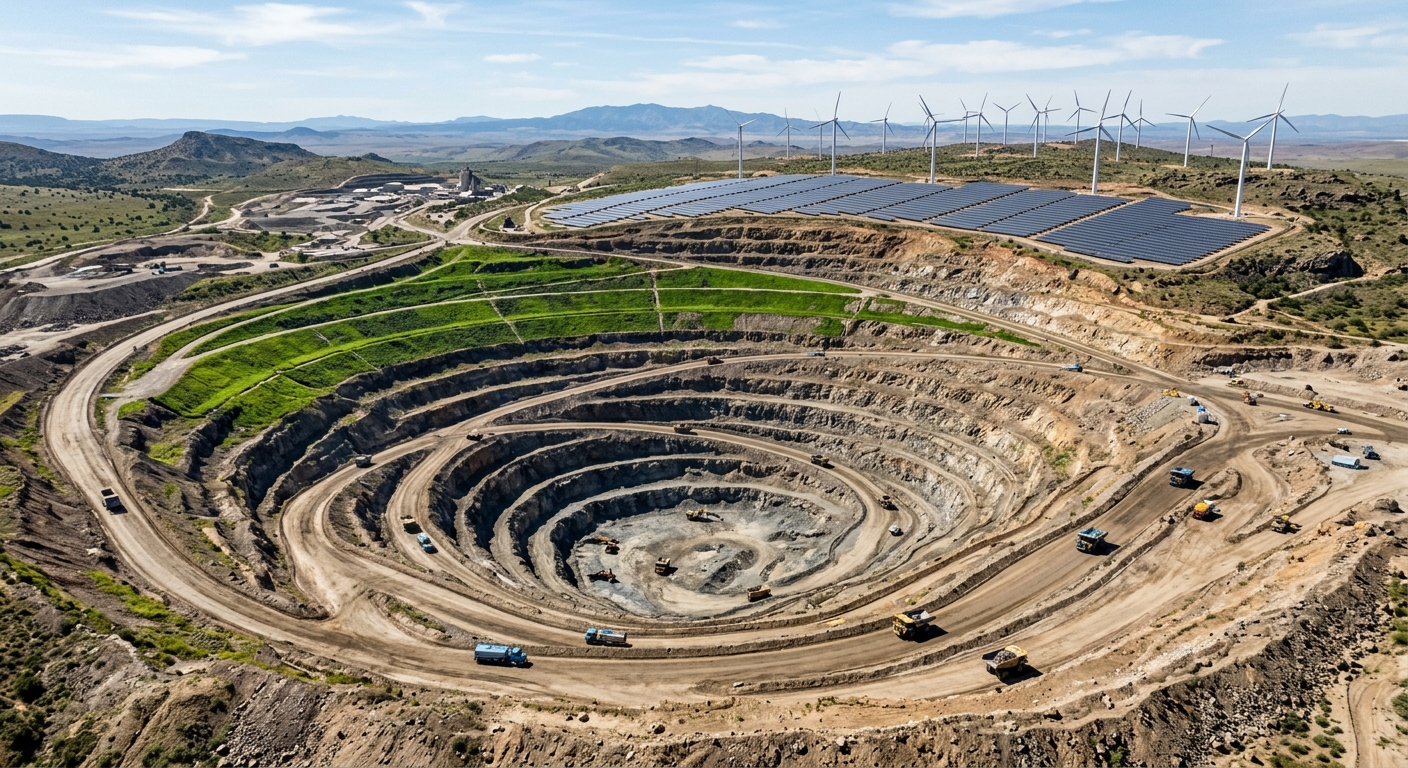
Fleet electrification is the next complication. BHP, Rio Tinto, and Fortescue are actively evaluating battery-electric haul trucks.
The simulation software must model kilowatt-hour consumption per tonne-kilometre alongside diesel litres, accounting for charging infrastructure constraints, battery degradation curves, and the different energy profiles of electric drivetrains on steep gradients. Platforms that cannot incorporate mixed-energy fleets will face a capability gap as electrification scales.
Water management is often missed. The Grasberg mine pumps over 500 million litres per day. When dewatering pumps are powered by diesel generators, the associated carbon emissions can represent 10–15% of total site emissions.
Simulation platforms that model water management energy alongside haulage fuel identify optimisation opportunities that haulage-only models miss.
Regulatory pressure is increasing:
- Australian Safeguard Mechanism: facilities exceeding 100,000 t CO₂e annually, mandating a 4.9% annual baseline decline
- EU CBAM: definitive phase from January 2026, certificates on sale from February 2027, pricing the carbon content of imported minerals
- California SB 253: penalties of up to $500,000 per year, Scope 1 and 2 reporting from 2026, Scope 3 from 2027
For mining operations, Scope 3 emissions can represent up to 95% of total value chain emissions, making supply chain carbon accounting an unavoidable operational requirement.
What This Means for Your Software Evaluation
This is not a platform choice. It is an integration maturity that builds additional engineering capability on top of the governance foundation. The question is which layers your operation currently has in place.
Consider your current maturity position:
- Building a governance and compliance foundation: If your operation does not yet have a centralised system for emissions tracking, framework-mapped sustainability reporting, and auditable environmental records, the priority is establishing this governance infrastructure. Environmental and ESG compliance platforms provide the ledger that every subsequent optimisation depends on.
- Optimising strategic pit shells with carbon constraints: If governance is in place and you are evaluating long-term extraction strategies, the next capability is SNPV optimisation. Mine planning software with carbon cost parameters in the block model allows planners to evaluate the NPV impact of different carbon price scenarios at the strategic horizon.
- Optimising daily haulage for minimum fuel burn: If strategic planning includes carbon constraints and you are seeking shift-level optimisation, the requirement is DES with fleet management system integration — connecting actual fuel burn telemetry to the simulation model for continuous recalibration.
- Preparing for fleet electrification: If your operation has committed to battery-electric haul trucks or hybrid drivetrains, the simulation layer must model kWh consumption alongside diesel litres, including charging infrastructure constraints and battery degradation curves. The carbon accounting methodology changes fundamentally when Scope 2 replaces Scope 1 for a portion of the fleet.
The integration architecture matters as much as the individual platforms. A common failure mode is deploying an ESG platform alongside a mine planning suite without building the data pipeline between them. The ESG team manually compiles quarterly emissions aggregates from fuel invoices while the mine planning team runs SNPV analysis against theoretical fuel curves. The two systems never reconcile.
Concurrent optimisation only works when actual operational emissions data flows back into the planning model continuously.
Diagnostic questions for your evaluation:
- Can your mine planning software accept a carbon cost parameter on a per-block basis within the block model?
- Can your fleet management system export actual fuel burn data per truck cycle via an API?
- Does your operation have middleware connecting fuel burn telemetry from the execution layer back to the planning model?
- Can your ESG reporting platform ingest granular, shift-level emissions data from the planning and execution systems, or does it rely on manually compiled quarterly aggregates?
Frequently Asked Questions
Common questions on this topic, answered concisely.
- How does the Australian Safeguard Mechanism affect mining operations?
- The Australian Safeguard Mechanism mandates a 4.9% annual baseline decline in emissions for facilities exceeding 100,000 tonnes CO₂e. For large mining operations, this converts ESG from a retrospective reporting exercise into a binding operational constraint — one that must be engineered into the mine plan itself rather than reported on after the fact.
- What is concurrent ESG optimisation in mine planning?
- Concurrent ESG optimisation is the practice of embedding carbon cost directly into pit optimisation and scheduling algorithms, rather than optimising for NPV alone and reporting emissions separately. This moves ESG from a Phase 1 governance activity (retrospective Scope 1/2/3 reporting in platforms like VelocityEHS, Sphera, and Cority) into a Phase 2/3 engineering workflow where every block extraction decision carries both an economic and carbon weight.
- What is the SNPV (Sustainable NPV) model?
- SNPV adds a carbon cost per tonne of CO₂e to the traditional NPV calculation used in pit optimisation (Lerchs-Grossmann, Pseudoflow). The result is a pit shell and schedule that trade off discounted cash flow against lifetime emissions, producing a plan that meets both financial returns and emissions baselines. Platforms implementing SNPV-style carbon factoring include Deswik.CAD, Maptek Evolution, and MineMax Scheduler.
- How do fleet management systems track carbon emissions at the shift level?
- Modern fleet management platforms (Caterpillar MineStar, Komatsu Modular Dispatch, Wenco, Epiroc Mobilaris) ingest on-board fuel sensor telemetry to produce shift-level diesel burn data. When combined with jurisdiction-specific emission factors (NGER, GHGRP, EU ETS), this converts haulage operations from an estimated Scope 1 source into a live, measured carbon stream that operations can optimise in near real time — the Phase 3 tactical endpoint of carbon management.
Related Categories
Explore the software categories referenced in this article.
Environmental & ESG Compliance
Phase 1: Governance, reporting, and audit: framework-mapped sustainability disclosure and environmental monitoring.
Mine Planning & Design
Phase 2/3: SNPV optimisation and carbon simulation: strategic pit design with concurrent emissions constraints.
Fleet Management & Dispatch
Phase 3: Real-time haulage fuel optimisation: actual fuel burn telemetry and dynamic route management.
Simulation & Digital Twins
Phase 3: Discrete event simulation for multi-objective optimisation: concurrent NPV and carbon minimisation.